Showing posts with label 5 stars. Show all posts

Thursday, June 8, 2017

Travel Reading: Madonna House Part 3

During the four months of reading the below books, I've been at a farming community in the middle of nowhere (if anything can be called "the middle of nowhere", rural Canada can), with no electronics. It is far too difficult to write up proper reviews in these circumstances, so I'm continuing the Travel Reading series, where I simply write a couple sentences about each book read, and leave it at that. Here goes the third set of three:

"Poustinia" by Catherine Doherty
Grade: 3 1/2 stars
I love the idea of Poustinia--it's epic. And some of Catherine's ideas are just so true and beautiful, and not something you see talked about anywhere else (at least in our culture). But I struggled a lot with her style, especially her seeming anti-intellectualism. This was a very up-and-down reading experience for me because of that. But I recommend this heartily! I think almost anyone could get something new and helpful out of it, at least.


"The Power and the Glory" by Graham Greene
Grade: 5 stars
SO Catholic, in the best possible sense of that phrase. Greene gets so many things--what real sanctity is, the silliness that is sin, and how people think deep down to themselves. He reminds me of a grittier version of C. S. Lewis in those ways. This is a book worth a good, long sit-down discussion over beer or hot chocolate. Yet all this might give the impression that it's a "difficult" book, or preachy, or only relate-able to Catholics or something, but that's totally false. It's easy to read, excellently written, brilliant characters, gets to the bottom of LIFE. Man, I don't even know how to describe my thoughts properly, but I am so glad I finally got around to reading this.


"In the Night Garden" by Catherynne M. Valente
Grade: 4 stars
The structure of this book! It totally thrilled me. A layered, interlocking series of tales and stories, with unexpected connections and call-backs and Inception-like depth. The unending nature of the structure was a little annoying for me personally, though. I wanted everything wrapped up in the end, in an incredibly complex bundle of imagination and creativity. Instead it emphasizes the fact that stories don't really have a beginning and end, which is probably actually the best route to take, despite my personal preferences.


"The Return of the Prodigal Son" by Henri Nouwen
Grade: 4 stars
A beautiful little book that gives you a new appreciation for Rembrandt's famous painting. I didn't find it quite as helpful as the last Nouwen I read, but excellent none the less.


"Shirt of Flame" by Heather King
Grade: 5 stars
Profound and difficult and consoling simultaneously. It came at an absolutely perfect time in my life, and gave me a relationship to St. Therese for which I'll be forever grateful. Also good coming so soon after The Power and the Glory, since King also get the grittiness and paradox and beauty of Catholicism.


"Paladin of Souls" by Lois McMaster Bujold
Grade: 3 stars
The gods in this series! With the religion in this series, and how Bujold presents the theist character of Cordelia in the Vorkosigan saga, I can't help but think she's had some experience of Faith. She just seems to get how it works (though the Bastard weirded me out a bit...). The rest of the aspects of this story were good enough, and entertaining, but I think the first book, The Curse of Chalion, remains my favourite by a large margin.


(There are some personal notes below this break. Feel free to skip them; they are pretty unintelligible anyway.)

Wednesday, June 22, 2016

A Silent Voice

by Yoshitoki Ooima

Story summary: From the description of the first volume on Goodreads:
"Shoya is a bully. When Shoko, a girl who can’t hear, enters his elementary school class, she becomes their favorite target, and Shoya and his friends goad each other into devising new tortures for her. But the children’s cruelty goes too far. Shoko is forced to leave the school, and Shoya ends up shouldering all the blame. Six years later, the two meet again. Can Shoya make up for his past mistakes, or is it too late?"

Why You Will Like This Series:
  • Complex people and relationships--messy like real life.
  • Slow growth in friendship, self-respect, courage, and living.
  • The realistic emotions the art managed to portray staggered me sometimes.
  • The romance was pretty much the cutest thing ever, though not as important as even I wanted it to be.
  • With only seven volumes, it's a nice and short and manageable read, and didn't continue past it's expiry date (unlike many series).

And Why You Might Not:
  • This IS manga. A lot of people I know find it difficult enough to read normal graphic novels, let alone ones structured backwards to match the original language's format.
  • I could see this being triggering to people who've struggled with depression, anxiety, suicidal thoughts, and the like.
  • The ending is more open-ended than many people liked. (Not totally sure what I think of it myself.)

Thursday, March 24, 2016

The Thrilling Adventures of Lovelace & Babbage

by Sydney Padua

Why You Will Like This Book:
  • What if Lovelace and Babbage, inventors of the first computer, didn't die young and disappointed respectively? What if they actually built their computer, and when on to have thrilling adventures with it after that?
  • This is the subtitle (and how could you not like a book with a subtitle like this?): "With Interesting & Curious Anecdotes of Celebrated and Distinguished Characters Fully Illustrating A Variety of Instructive and Amusing Scenes; as Performed Within and Without the Remarkable Difference Engine"
  • It's a graphic novel! But with so many footnotes and endnotes that it's basically a normal book! But the footnotes are way better than a normal book cause they're so funny and interesting!* Cause history is weird, man.

And Why You Might Not:
  • It purposefully goes off into an alternate universe, with historical inaccuracy. I love this aspect, but it's one of the only possible things I could think of that you might not like.

Friday, February 12, 2016

Let Your Life Speak

by Parker J. Palmer

Why You Will Like This Book:
  • It's beautiful, poetic, true, unusual.
  • But with all this, it's very easy to read (and short).
  • And I think it's ideas might be very important indeed for our modern life, where people forget their human nature.

And Why You Might Not:
  • It's not Catholic, and often not specifically Christian. Some could be put off by this, because the ideas, though (I think) terribly important and true, could easily be misconstrued without the understanding of Christian moral theology.
  • And that's my only criticism, because it's beautiful.


Wednesday, October 14, 2015

Gay and Catholic

by Eve Tushnet

Why You Will Like This Book:
  • Orthodox Catholic, yet gritty and real.
  • Written in an amusing and engaging style, drawing much from her own experiences.
  • Discusses really important topics to our times: love, community, friendship. All of which are under appreciated or misunderstood these days.

And Why You Might Not:
  • She doesn't try to explain the Catholic teachings on sexuality. If you're looking for a good way to convince people or yourself, this is not it.
  • Some of this might bother you, whether you agree or don't agree with the teachings of the Church on human sexuality. She is upfront enough with her sexuality, and compassionate to other LGBTQ people, that a traditional Catholic could be uncomfortable (though she is completely orthodox herself), and she is Catholic enough that a normal, non-homophobic, non-Catholic person could think her ideas lacking in tolerance.

Friday, October 9, 2015

Retro Friday Review: Sir Hereward and Mister Fitz

by Garth Nix

Retro Friday Introduction:

Retro Friday is a weekly meme hosted by Angie @ Angieville and focuses on reviewing books from the past. This can be a favourite, an under the radar book you think deserves more attention, something woefully out of print etc.

Garth Nix is a decently well known Australian fantasy author, probably most famous for his Sabriel series (which is also fabulous). I think all of Garth Nix's books are more under the radar than they should be (despite him being well-known among young-adult fantasy aficionados), but this little book is probably the worst off. However, it is also among my favourite collections of short stories I have ever read. Perfect book for a Retro Friday.

Story summary: In these three short stories, a young soldier and his magical puppet sidekick* travel the land on their mysterious business, having adventures with giant starfish, duels, beautiful soldier women, cannibalistic pirates, and god-possessed captains.

Why You Will Like This Book:
  • The world-building is amazing and so cool and gives this sense of vast history. Plus it's just fun. I want mooooooore.
  • It has all the adventure and brotherhood and Classic writing style of The Three Musketeers within the world of an epic and original fantasy series.
  • Short stories can sometimes pack a greater emotional punch for me, as everything is concentrated and everything superfluous cut out. So it is with these.

And Why You Might Not:
  • This is written in the old-fashioned, Three-Musketeers-type-adventure style, the worst part of which is the "sleeping with every pretty woman" aspect. Fortunately, the women are fascinating, well-written characters, so this ends up actually being mostly a benefit.
  • I love this book whole-heartedly, so I had to look up other people's reviews to find some possible criticisms for this section. (Apparently not everyone has the same taste as me! Who knew!) Mainly some people thought it was too dark, and some didn't like the format of short stories and thought it would work better with more information and story. Both of which I could see as being legitimate reasons not to like it, if you were a person-who-is-not-me.

Friday, September 4, 2015

Retro Friday Review: Archer's Goon

by Diana Wynne Jones

Retro Friday Introduction:


Retro Friday is a weekly meme hosted by Angie @ Angieville and focuses on reviewing books from the past. This can be a favourite, an under the radar book you think deserves more attention, something woefully out of print etc.

This Friday, I chose Archer's Goon, the short, weird, but wonderful book about a family of megalomaniac wizards trying to rule a small town and the ordinary family who accidentally gets in their way. I reviewed it when I first read it back in September 2008, but it was a terrible and very short review. It deserves better.


Story summary: The Sykes are living their ordinary family life, with unwanted music lessons and awful little sisters, until one day, there's an enormous goon in their kitchen. He demands that Mr. Sykes (an author) write two thousand words (any words) for his boss Archer. It turns out Archer is one of seven wizard siblings ruling the town and battling each other for power. And all of them, in their own ways, are out to get Mr. Syke's two thousand words.
Can the Sykes survive the plots and machinations of seven self-absorbed wizards? Will they ever figure out what the heck those two thousand words are all about? And just how does your mother expect you to practice violin when you have imaginary spaceships to design?


Why You Will Like This Book:
  • Family. It's all about family: dysfunctional, chaotic, funny, surprisingly loving and surprisingly heartless.
  • Twists, complexity, originality, weirdness, chaos.

And Why You Might Not:
  • As with many of Diana Wynne Jones books, how everything comes together in the end can seem a little rushed and lacking in coherency upon first reading. This is a lie, though. She has everything work together meticulously, you just have to pay attention. (Re-reads really help clarify this.)
  • It is a weird book. And not extremely deep with the most complex characters or anything. If you're looking for something that isn't funny, strange, light, subtle, and family-friendly, then you probably won't like this.
  • None of the covers are pretty. None of them. None of them get the feel of the book right, let alone look at all interesting and attractive. I was thrown off this book for quite a while due to the unappealing covers.

Saturday, July 25, 2015

The Goblin Emperor

by Katherin Addison

Story summary: Maia's life in seclusion with his cousin is completely changed when his father and step-brothers all die in an airship crash. Especially since it so happens that his father was the emperor, and now Maia is the last heir to the throne. But not only has Maia not been taught anything about the mechanics of ruling an empire, but he's half-goblin in an elven court filled with politics and factions and politics and agendas and politics.

Why You Will Like This Book:
  • Almost definitely the best book I've read this year so far.
  • Introspective character study.
  • The POLITICS.
  • Examination of a very realistic fictional culture.
  • So many wonderful subtle relationships between characters.

And Why You Might Not:
  • You get totally dropped into this strange world with no explanations except a glossary and couple short pages describing language conventions. I love this; it makes everything far more interesting. But you have to be in the mood to enjoying flipping back and forth and puzzling out what people are talking about to properly enjoy this book.

Saturday, May 10, 2014

Memory

by Lois McMaster Bujold

Story summary: Miles finally reaches a bit too far, and one of his clever, seemingly-impossible schemes ends as expected for once: badly. He is stripped of what he holds most dear, and his life (as he sees it) is pretty much over. And then on top of this utter misery, things start to go subtly wrong on Barrayar.
See the others in this series: Shards of Honor, Barrayar, The Warrior's Apprentice, The Vor Game, Cetaganda, Brothers in Arms, and Mirror Dance.

Thoughts: Most of my reviews for these books end up seeming rather similar. I exclaim that the book is marvellous, and then gush over the characters for a while. But one of the amazing things about this series is actually how different they are. Their excellent writing and fascinating characters are some of the few things that remain consistent (ignoring the similarities that obviously occur from taking place in the same world and focusing on pretty much the same set of characters). This one was more a psychological study/mystery story with some romance, as opposed to the adventure of the first few books, or the psychological study/adventure of Mirror Dance, or the more straight romance that I gather some of the future books are.
But I am not good enough to analyze it properly (you can see some really good analysis at Tor.com, though). So here goes the standard gushing:

This one had a lot of focus on Simon Illyan, which I was extremely pleased about. Illyan has been one of my favourites since he was first introduced in Shards of Honor, but there's been less about him than all my other favourite secondary characters (Cordelia, Ivan, and Gregor, mostly). But the main plot of this book centres around him, so he gets lots of character development. Also, Gregor's part in this book was absolutely lovely, and rather hilarious.

I was worried that I wouldn't like the later books in this series as much as the first few, with the emphasis on society and romance as opposed to adventure and frantic cleverness. But I should have trusted. Because, man, I love these books. They are just so good. They have depth and keen insights into human nature as well as lots of humour and adventure. I love almost every character that comes along, and I always finish feeling glowing and satisfied. They are everything I could want in a series. I'm sure they will remain among my favourite books for the rest of my life.

Grade: 5 stars

Wednesday, April 23, 2014

Mirror Dance

by Lois McMaster Bujold

Story summary: I don't really want to explain this plot in too much detail. Suffice it to say, it concerns Mark, who was introduced in Brothers in Arms. Thus, there is more twisty identity stuff, and lots of character development.
See the others in this series: Shards of Honor, Barrayar, The Warrior's Apprentice, The Vor Game, Cetaganda, and Brothers in Arms.

Thoughts: Wow. This was...intense. And rather brilliant. Although I found the first bit slightly less interesting, but then everything starting from Barrayar afterwards was fascinating. It seems to be a lot of people's favourite of the series, and I can see why. The Warrior's Apprentice or The Vor Game might still be my personal favourite; I will have to do a re-read of the whole series to find out! hurrah! But this one is most certainly the darkest since the stuff with Bothari in Shards of Honor. And I mean dark in a good way; it's the gritty stuff that stays with me and makes me think.

As always with these books, it's the characters that have my heart and soul. And because much of this takes place on Barrayar, we get to see a lot of Cordelia and Aral again, as well as Gregor. And Ivan is around as always. The fascinating thing about this book was being able to see everyone from the outside, from Mark's point of view. Ivan's scenes, for instance, were amazing. I've always loved Ivan, and each book I love him more.This was definitely the best one for him yet. (I loved Cordelia's little comment about his intelligence.) And of course, we got to see Miles himself from the outside. Although I found what was most interesting was seeing the effect of Miles from the outside, as opposed to Miles himself. Here's a short paragraph concerning Miles a.k.a. Naismith (thought by Mark):

"He could always tell, instantly, when someone he met thought they were facing "Naismith." They all had that same stupid hyper-alert glow in their faces. They weren't all worshipful; he'd met some of Naismith's enemies once, but worshipful or homicidal, they reacted. As if they suddenly switched on, and became ten times more alive than ever before. How the hell did he do it? Make people light up like that? Granted, Naismith was a goddamn hyperactive, but how did he make it so freaking contagious?" (from page 315 of the Miles Errant omnibus)

Miles is one of those charismatic fictional people that reminds me a little bit of Eugenides, from Megan Whalen Turner's "Queen's Thief" series. They are "kings", in some sense of the word; they have a certain innate power over people (should they choose to exercise it). Strange, mad, brilliant people they are, and I love them. As his own mother says of him, "I grant you he's a genius, but don't you dare try to tell me he's sane." (pg. 473)

This definitely deserves its 5 star rating, for me. It encompasses the best of the character development of the series so far, which is saying something since character development is always superb in these books. And there are so many awesome little poignant scenes. For me, these are always the ones that stand out. Every once in a while I will like a book solely for its excellence overall, but it's almost always the presence of a few spectacular scenes (not really mattering what the rest of the book is like) that does it for me.

It makes me sad. Every book I finish in this series means one less book I have left to read. I also keep thinking, "Surely it must have peaked by now. The rest of the series after this book won't be as good--they can't continue being So. Darn. Good." But they do.

Note: all page numbers come from the Miles Errant omnibus.

Grade: 5 stars

Saturday, February 8, 2014

To Be Or Not To Be: A Choosable Path Adventure

by Ryan North, William Shakespeare, and YOU

Grade: 5 stars
Story summary: Hamlet. As a Choose Your Own Adventure story. Enough said.

Thoughts: I gave this 5 stars not because it was so terribly brilliant, or the best book I'd ever read, but because it is perfectly suited to me. This is pretty much the book I wish I had written. I mean, it's Hamlet as a Choose Your Own Adventure story. I've always loved Choose Your Own Adventure stories, and this one is hilarious and meta and so thick and full of good stuff--I completely love it. I don't want to spoil too much, but there is so much awesome in this that I think I'm fairly safe. So as some examples: there is the ending where you get to turn into a gamma-irradiated monster (pg. 274), or the one where you're suddenly in Macbeth (pg. 260), or super awesome ones like the one where you get 50 billion decapoints for doing such a great job (pg. 719). And there are tons of somewhat normal ones, where you settle down with Ophelia or do projects that are good for the economy or murder the whole town. There's also a way where you can follow the actual story of Hamlet, the choices marked with Yorick skulls.

(I always do the first run through one of these books trying to choose exactly as I would as myself in real life. Through this method I (as Ophelia) helped Hamlet put Claudius in prison by working through the legal system. I got 100 out of 100 LEGAL JUSTICE POINTS, but only 3 ADVENTURE POINTS, because it was sort of a boring ending. (pg. 160))

If I had to have any criticism, it would be that Ryan North didn't always seem to have the best understanding of some of the themes and happenings of Hamlet. As one example, he didn't seem to understand why Hamlet didn't want to kill his uncle while his uncle was praying. Which I actually find a rather fascinating insight on how far Hamlet has gone by that point. But since the whole book was rather silly and completely for fun, these little issues really didn't bother me.

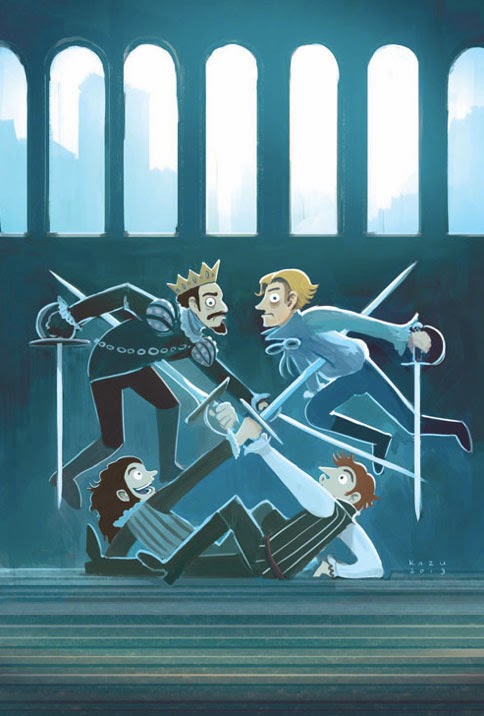
Also, coming back to the awesomeness: every single ending is fabulously illustrated by a different artist (many of whom I recognize from webcomics and such on the internet (e.g. Ethan Nicolle from Axe Cop!!!)). Here are two sample illustrations for your viewing pleasure, but there are many more awesome ones.


P.S. This is just for me, or for people that have already read the whole book, but I wanted to make note of some of my favourite parts and endings so I could reference them later if I wanted to (and not have to search the whole darn book). This will be encoded in rot13 to prevent spoilers, but you can translate if you want.

V ernyyl guvax gung zl snibhevgr raqvat jnf ct. 356, jurer Ubengvb tbg gb unir uvf bja fznyy nqiragher. V'ir nyjnlf unq n fbsg fcbg sbe Ubengvb, rira gubhtu ur qvqa'g ernyyl qb zhpu va gur cynl. Naq V gubhtug gur jubyr "Lbh or TERNG" ynfg yvar jnf dhvgr fjrrg. Gur raq ba ct. 379 jnf nyfb npghnyyl engure vafcvevat va n fvzvyne jnl.
Naq gura gurer jrer gur qbjaevtug uvynevbhf raqvatf...  V guvax V jvyy svaq gur cvpgher bs Unzyrg ynlvat ba gur sybbe orvat "pnfhny" va sebag bs gur fgnoorq phegnva crecrghnyyl shaal. (Cvpgher ba ct. 607, sebz gur raqvat ba ct. 26.) Fvzvyneyl gur raqvat ba ct. 75 jvgu gur cvpgher ba ct. 163 (gubhtu sbe fbzr ernfba V svaq gur cvpgher ba ct. 607 fyvtugyl shaavre). Gur raqvat jurer lbh qrpvqr gb qvgpu ernyvfz nygbtrgure (sbetrg gur cntr..., cvpgher ba ct. 197), gur bar jurer lbh nf Bcuryvn trg n ernyyl zhfpyrl nez ("Naq va gur raq...vfa'g gung gur zbfg jr nyy pna ubcr sbe?") (ct. 624), naq gur bar jurer, ybat fgbel fubeg, vg gheaf bhg xvyyvat Cbybavhf, phggvat uvz hc, fghssvat uvz vagb ontf, naq chggvat gur ontf vagb fgrj oevrsyl bayl gb erzbir gurz vf vyyrtny? (ct. 541)
Gurer jrer whfg fb znal njrfbzr raqvatf... gur bar jurer vg gheaf bhg lbh'er va gur Tubfgohfgref zbivr abj (ct. 233), be gur bar jurer lbh ohvyq n znpuvar gb perngr n arj gvzryvar (ct. 229) naq unir gb qb pbzcyvpngrq zngu gb raq hc ba guvf arj gvzryvar (ct. 158) jurer lbh zrrg gur bgure irefvba bs lbhefrys (naq trg n ybat n yvggyr gbbb jryy...). V guvax glvat sbe svefg jvgu gur Ubengvb raqvat zvtug or gur bar gung fcrpvsvpnyyl gryyf lbh vg'f na njrfbzr raqvat: ba ct. 268, lbh, nf gur tubfg bs Unzyrg, wbva sbeprf jvgu lbhe qrnq sngure va n uhtr tubfg-ba-tubfg jner sbe gur fheiviny bs gur nsgreyvsr. Lbh ner yrnqvat gur nezvrf bs uhznavgl'f terngrfg tubfg vagb onggyr, naq znxr n fhcre qenzngvp cer-onggyr fcrrpu. "Yrg'f qb guvf, Unzyrg," Senaxyva Q. Ebbfriryg fnlf, pbpxvat uvf fubgtha. Guvf vf na njrfbzr raqvat.
Naq bs pbhefr, gurer jrer cyragl bs njrfbzr ovgf fcevaxyrq guebhtubhg gur obbx, orsber lbh rira tbg gb na raqvat. V ybirq Bcuryvn naq Unzyrg'f ybat "Jnlf gb Zheqre n Xvat" yvfg (ct. 538), naq gur jubyr "Pubbfr Lbhe Bja Nqiragher" fgbel jvguva guvf "Pubbfr Lbhe Bja Nqiragher" fgbel, naq nyy gur ersreraprf gb bgure  aba-rkvfgrag "Pubbfr Lbhe Bja Nqiragher" fgbevrf (yvxr gur njrfbzryl zrgn qvfphffvba jvgu gur nhgube ba ct. 10),  be gur yvggyr ovg ba ct. 337 gung vg gheaf bhg lbh pna'g trg gb guebhtu nal cngu (orpnhfr vg jnf vafregrq guebhtu gur gvzr-fcnpr pbagvahhz ol gur Bzrtn Cebgbpby...ybat fgbel). Naq gura gurer jnf gur ubarfg-gb-tbbqarff genvavat zbagntr! (ct. 508) V ybbbir genvavat zbagntrf!!!

Maaaaan, this P.S. went on for a long time... Sorry... this book makes me very enthusiastic, even when I'm just making notes for myself in code so noone can read them.

Monday, September 30, 2013

The Warrior's Apprentice

by Lois McMaster Bujold

Grade: 5 stars
Story summary: Sequel to Shards of Honor and Barrayar (chronologically speaking--the order of publication is quite different), starring Miles, the son of the magnificent main characters from those books. Also features battles in space, manipulations, lies, and the "accidental" creation of an entire mercenary fleet.

Thoughts: Miles Vorkosigan. I am fully and completely in love with him.

He's the sort of person that will cover up his small lies by telling really massive lies, and then somehow, through all the plots and chaos and manipulations, the lies will end up true. He's one of the the few people that can match Moist von Lipwig (from some my favourite Discworld novels, Going Postal and Making Money) in pure, brazen audacity and "manic 'forward momentum'"*. As Moist himself says, "If I am going to fail, I would rather fail spectacularly".

He's the sort of person that has this strange effect on the people around him. In this way, he's one of the only people I've met (perhaps the only?) whom I feel like I can properly compare to Eugenides, from the Queen's Thief series by Megan Whalen Turner. (You might not realize how important this is, but it really is! Eugenides pretty much tops everybody as a character for me.) There's a similar sort of charisma and presence. If he for a moment switches his entire attention on you--well, you're not going to come out of that the same.  And somehow, people find themselves following all sorts of insane schemes that they'd never dream of trying normally.

To sum up in the words of one of his men: "Your forward momentum is going to lead all your followers over a cliff someday. On the way down, you'll convince 'em all they can fly. Lead on, my lord. I'm flapping as hard as I can."

Really, this book is all about Miles. I could talk about the plot and secondary characters, as they are quite excellent. But the plot events are pretty much all brought about through him, and many of the great secondary characters are put into focus through his relationships to (and manipulations of) them.

There is one thing I want to discuss briefly that is a huge spoiler. Visit rot13.com to decode it:
Obgunev...ubj pbhyq ur qvr fb rneyl va gur frevrf! Ur jnf fhpu n snfpvangvat punenpgre, naq znqr fhpu na vzcnpg ba gur punenpgref va gur svefg guerr obbxf. Fvtu. Vg vf irel fnq.

P.S. I've heard lots of talk about how horrible the covers for this series are. Are they really that bad? I mean, they could be better, obviously. But they never struck me as being that horrible... Anyway, I was just mentioning it in case anybody was turned off by the cover image up there. Please, in this case at least, follow the old proverb about not judging books by their covers.

P.P.S. I also want to emphasize that these are adult books, and widely acclaimed throughout the SciFi community (winning lots of Hugos and other awards). In other words, although you might get the impression that this is more similar to my usual fare of YA and children's SF/Fantasy, there is depth and excellent writing--especially as the series progresses. (Not that YA and children's don't have that, of course.) Basically what I'm trying to say is, they're fabulous and you should read them, even if it might not seem like your type of book. I keep getting terribly worried that something I say in this review is going to turn you off, and it really shouldn't!

*Quote taken from the Goodreads description.

Sunday, March 17, 2013

Reflections on the Magic of Writing

by Diana Wynne Jones

Grade: 5 stars

Thoughts: This is a collection of essays, transcripts of talks, and interviews by and about the fabulous, amazing children's author Diana Wynne Jones. She was one of the few people that I could always count on to write a book that I would greatly enjoy, and her books were unique and funny and full of awesome characters. When she passed away recently, I was sad and mopey for an entire week. She and this book deserve a much more brilliant review, but I can at least point you towards Neil Gaiman's introduction at the beginning of this book. (I mean, Neil Gaiman writing about Diana Wynne Jones. You practically can't get cooler than that.)

DWJ had a fascinating life. She went to lectures by both J.R.R. Tolkien and C.S. Lewis in university. ("Lewis booming to crowded halls and Tolkien mumbling to me and three others." (pg. 290)) She once lived in the house that the kids from Arthur Ransome's book lived in, and Arthur Ransome himself lived in a houseboat nearby. (He would complain about all the noise DWJ and the other children would make. (pg. 135)) Beatrix Potter also lived near this house, and once slapped Diana's sister and her friend for playing on BP's front gate. (pg. 135) It's so strange to think of all these writers as real, actual people (with faults and everything!). Her parents were neglectful and her life was full of strange people and events. But perhaps the most insightful essays were the two by her sons at the very end of the book. After all the descriptions of the nastiness of her parents and the strangeness of her life, her sons' perspectives gave a sudden twist on all of that, and gave a whole new view on who DWJ was. It was the perfect end to this collection.

But my favourite thing about this book wasn't the biographical details of a strange and interesting life, but her ideas on writing for children vs. writing for adults, and her thoughts on fantasy. "Two Kinds of Writing" (pg. 33), about children's vs. adults books, was one of my favourites. "[S]everal grown men confessed to me that, although they were quite shameless when it came to hunting through the juvenile sections of libraries and bookshops, they still felt incredibly sheepish on a train reading something that was labeled Tenn Fiction. Why? I wondered. The assumption underlying their sheepishness seemed to be that teenage fiction counts as just close enough to adult fiction to be seen as regressive, whereas if they are seen reading a children's book, that counts as research. In neither case are they assumed to be enjoying the book for its own sake." (pg. 33) She talks a lot in this essay about how in writing for adults, you often end up having to explain more, not less, which I've always thought, but I doubt many people would believe me. To quote DWJ again, "Here we have books for children, which a host of adults dismiss as puerile, overeasy, and are no such thing; and there we have books for adults, who might be supposed to need something more advanced and difficult, which we have to write as if the readers were simpleminded." (pg. 35) I could talk forever on this topic and elucidate a lot more, but this is already the longest review I've ever written, so I should go on to the next part of this topic.
I also especially loved "A Talk About Rules" (pg. 99), which talked about all the pre-conceptions about fantasy, and what people considered (wrongly) the absolute necessities of the genre. She talks about a man who could manage to read  The Fellowship of the Ring because he pretended it was all an allegory, but then once he came to the Ents, he completely gave up, because walking trees could only possibly be for children. (Man, it bugs me when The Lord of the Rings is listed as a children's book. IT'S NOT. Yes, children can read it (I did), but it is NOT A CHILDREN'S BOOK.) She talks about how people often insist fantasy (and children's books in general) must "teach" something (about divorce, bullying, etc. etc.), or  that any fantastic lands children travel to should be shown to be in their heads. Oh, there is so much here--I really can't get into it properly.

Couple other random notes:

  • It was nice that although DWJ was not Christian, she could still enjoy C.S. Lewis a lot. I find it quite a annoying how many people nowadays seem to a) misunderstand a lot of the points Lewis was trying to make, and b) think he's not worth reading because he often writes Christian allegory (while often simultaneously lauding Philip Pullman for writing what's basically the atheistic equivalent).
  • "Less than five years ago it was a truth generally acknowledged that anyone who could follow the plot of Doctor Who could follow anything. Maybe that was going a bit far the other way, but.. anyway, most adults professed to like their books simpler than children did." (pg. 112) YAY, Doctor Who!!! Nice to see its genius recognized. And see, I KNEW children's books (or in this case, TV) could often be far more complex and subtle than many things written for adults!
  • "Most recently, I have had a whole crop of letters from guilt-ridden students. These are mostly in their first year university and not altogether happy in it, and they are afraid that there is something wrong with them because they're still rereading and enjoying my books at the advanced age of eighteen or nineteen." (pg. 177) Hah! Silly people. This whole book makes me feel very vindicated for being a university student who still revels in the joys of children's books. (Also see pg. 179 for more on university students' somewhat erroneous view on children's books.)
  • The Tolkien essay, "The Shape of the Narrative in The Lord of the Rings", was rather magnificent. As much as I adore Peter Jackson's movies (and always will), I think this essay would have been good for him.
  • "The Heroic Ideal: A Personal Odyssey" (pg. 79) was another one of my favourites. Fire and Hemlock is one of my favourites of all her marvellous books, and it was amazing how much structure and shape and thought went into this book. As Neil Gaiman said in his introduction, "It [is] easy [...] to forget what an astonishing intellect Diana Wynne Jones had, or how deeply and how well she understood her craft." (pg. xi) Man, though, she made writing seem like a lot of work in this essay.


NB: All the quotes and references are taken from the hardcover edition, from Greenwillow Books.

Friday, February 8, 2013

Reflections on the Psalms

by C. S. Lewis

Grade: 5 stars

Thoughts: C. S. Lewis is faaaabulous. He starts out right off the bat with tackling the difficult stuff: the curses and and the death and the law and the judgement. One of Lewis's strongest points is making analogies to help understand difficult concepts like this, so of course this part was great. But my favourite chapter by far was "Nature". Here he discussed my current theological pet peeve:
"[T]he difference between believing  in God and in many gods is not one of arithmetic. As someone has said 'gods' is not really the plural of God; God has no plural." (pg. 82)
And this is not because Christianity believes that there is only one god or something--it's because the type of God Christianity believes in cannot by nature exist more than once. In fact, if there is more than one of that type of God, it is the same God. Thus the trinity. One God. Three persons.
Anyway, I'm rubbish at explaining exactly what I mean, and in cases like this, one kind of needs to be exact. But to sum up: the non-transcendence of God (as in capital-G God) in so much modern entertainment really bugs me, so it was interesting to see a similar idea discussed so many years ago.

There are so many other ideas he is excellent at explaining--I especially liked the chapter on non-literal meanings of scripture, and his discussion of The Song of Songs on page 128. (His shout-out to Ecclesiastes on pg. 115 was great too--Ecclesiastes is one of my very favourite books of the Bible.)

And here I'd like to quote the whole part about Akhenaten (one of my all-time favourite historical personages) from about pages 84-9, but that's obviously too long and I way behind on reviews. So read it yourself. Akhenaten is awesome, and C. S. Lewis is nicely balanced in his approach to him.

Friday, January 18, 2013

Retro Friday Review: The Masqueraders

by Georgette Heyer

Retro Friday introduction: This great book blog called Angieville started a meme called "Retro Friday", where one reviews old favourites. I thought this would be a great chance to talk about books that I read before starting this blog and am now re-reading, and perhaps to redo old blog posts that are sadly lacking in quality. Without further ado, here is Angie's regular Retro Friday intro followed by my thoughts on "The Masqueraders", which I recently re-read.


Retro Friday is a weekly meme hosted by Angie @ Angieville and focuses on reviewing books from the past. This can be a favourite, an under the radar book you think deserves more attention, something woefully out of print etc.

Grade: 5 stars
Story summary: Two adventuring siblings on the run from their involvement in the Jacobite rebellion cross-dress in order to avoid detection. Then follows adventures! escapades! duels at midnight! love and romance! shenanigans!

Thoughts: This is one of my favourite Heyers, along with Cotillion, A Civil Contract, The Grand Sophy, and Friday's Child. And as with the rest, it surprised me how much I liked it. Romance (and Historical Romance) is not generally my "thing". But Heyer manages, with those five at least, to make it so fun and interesting that I actually rather love it. Cotillion and A Civil Contract because they are so unusual for Romances, The Grand Sophy because Sophy is indeed one of the Grandest things there is, and Friday's Child because I have rarely read a romp so innocent and fun and lovely.
With the The Masqueraders, my love is for the relationship between the brother and sister, Robin and Prudence. I love good, strong sibling relationships in fiction--there are FAR too few of them. And together these two dazzle and deceive the upper-class with their wit and consummate acting skills.

Really, it's just so darned fun. There are tons of stories out there with girls masquerading as boys (from Shakespeare to many a modern YA book), but rarely any with boys masquerading as girls. And usually if that does happen, it's because the male in question is particularly feminine in some way. But here, though both siblings are much better than normal at passing for the opposite sex, they truly shine as their own. Plus, did I mention the duels at midnight? And shenanigans?  And last but not least, Robin and Prudence's father. He. is. amazing. I think it would have been awesome to have a book about all three of them having adventures together before the events of this book.

One unfortunate downside is that it can be pretty darn confusing at the beginning, before everyone is revealed to be who they actually are. I know people who have stopped reading it right near the beginning because of this. But once you get past that, or once you're at the re-reading stage, it's alllll good.

P.S. Robin and Prudence are so awesome that they made it onto my list of Top Ten (Or So): Conmen.

Friday, October 26, 2012

Death Note

written by Tsugumi Ohba
illustrated by Takeshi Obata

Grade: 5 stars

For reasons that are still rather vague and unformed in my mind, I do not count graphic novels/manga/comic books when numbering the books I read each year. But it occurred to me for the first time the other day that this wouldn't necessarily stop me from reviewing them. So here goes.

Death Note is one of the coolest series I've read in a long time, and I'm including non-graphic series as well. It contains many of my favourite tropes: young, evil geniuses; Machiavellian characters; long battles of wits. What more could I ask for?

It's basically about a long series of mind games between Light Yagami, a boy who obtains the power to kill people by writing their names in a notebook (the Death Note of the title), and a young genius detective called simply "L". Light slowly gets more corrupted by the power of the Death Note, and L slowly closes in on him. And just when you think you might understand someone's plan, it turns out there was a whole other level going on above that the whole time. Awesome stuff.

Special praise also goes to the artist, Takeshi Obata. He's what got me into manga in the first place, with Hikaru no Go. His style is not as frantically busy as some manga tend to be, and a series as dark as this needs some realism in its art.

My main criticism is a lack of interesting girls. Any girls that did appear tended to be rather stupid, and have no purposes other than being in love with Light, and thus getting rather horribly used by him. The lack of good female characters did mean that there was no hackneyed Romance, which was nice. But I would also very much like some girls to add to my Evil Child Geniuses list someday.

It also gets into slightly weird philosophy by the end of it. Mostly this wasn't the focus of the story, though, so I was able to ignore it.

Friday, September 14, 2012

A Face Like Glass

by Frances Hardinge

Grade: 5 stars
Story: I have made a decision not to write a story summary for this. It's not that I would spoil too much, or anything. It's just that I like to go into Hardinge's books with no clue what's going to happen. Plus a summary of the first bit of the story isn't really going to give you any clue about what the rest of it is like. But here's a couple exclamation points, just to start you off (it's really only the beginning, though): Cheese-making! Revolution! Exodus! Court intrigue! Weird, creepy, kind-of-scientists!

Thoughts: Hardinge is one of the most original Middle Grade writers I've read, and one of the only authors I'll buy on sight, without reading a single review, description--anything. Her world building is utterly unique, not only from all the other authors, but from the rest of her own books as well. In this book, there are the Cartographers, the Facesmiths, the Cheeses and Wines and Perfumes... all of which you'd have no idea about unless you read this book.

The characters, plot, etc. are all great too, though it's the world-building which stands out the most here (unlike her some of her other books, Fly By Night and Twilight Robbery, where the characters of Mosca Mye and Eponymous Clent dominate my memory). The plot is full of twists and lies and secrets. The short quote on the back of the books sums it up nicely:

"Child, thief, madman, spy – which speaks the truth and which one lies?"

P.S. I highly suspect I would cave even faster than most people to the lure of the Cartographers. Even though I had the safety-net of reading about them in a book and not being physically present, they almost got me. I half wished Neverfell would drop all her plans and become a Cartographer, just so I could find out more about them and hear them talk.

Sunday, March 25, 2012

A Posse of Princesses

by Sherwood Smith

Grade: 5 stars
Story: Rhis, a princess of a small, mountainous country, dreams of adventure and romance. So when she is invited to the grand, multi-day homecoming party of Prince Lios (of a neighbouring country), to which all the young princes and princesses of the area are invited also, she is obviously quite excited.

Thoughts: Well that was warm and fun and lovely and I loved it. It reminded me of Year of the Griffin by Diana Wynne Jones, with lots of different characters from all sorts of fictional cultures, not exactly any villains, and lots of matching up of people in the end. Plus lots of fun and adventure.

P.S. Apparently the ebook version, which I read, has an extra chapter or something? And there are less typos? I'm not sure, but just to warn anybody who might read it.